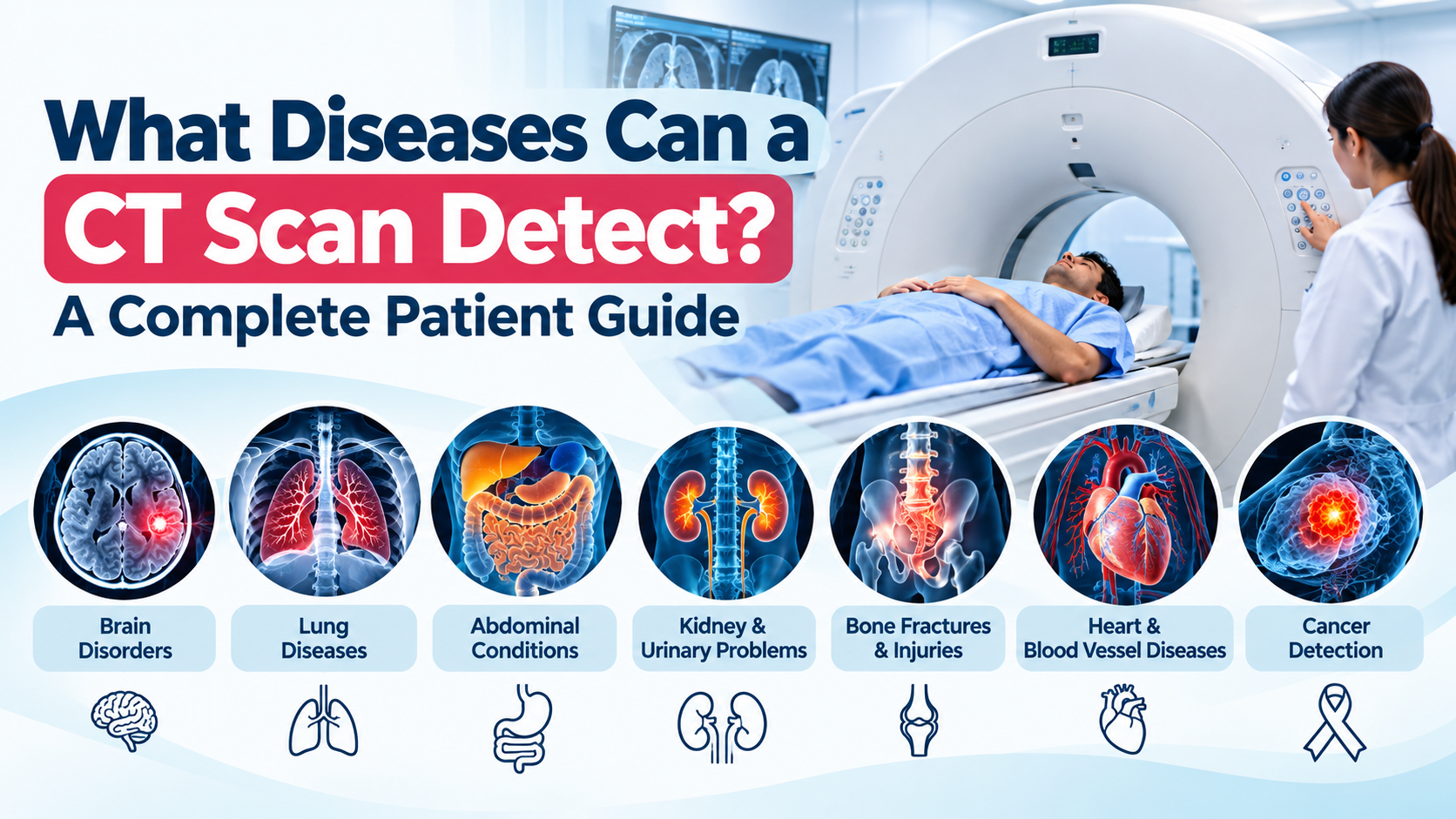
A CT scan (Computed Tomography scan) is an advanced medical imaging test that helps doctors examine internal organs, bones, blood vessels, and soft tissues in detail. It combines multiple X-ray images to create cross-sectional pictures of the body, allowing doctors to identify injuries, infections, tumours, and other medical conditions.
Doctors may recommend a CT scan when they need detailed information about a particular body part or when other diagnostic tests do not provide sufficient information. From detecting kidney stones to identifying lung infections and internal injuries, CT scans play an important role in modern medical diagnosis.
In this guide, we will explore the different diseases and medical conditions that a CT scan can help detect, its common applications, preparation guidelines, and factors affecting the CT scan cost.
1. Brain Disorders and Neurological Conditions
A CT brain scan is commonly recommended when doctors need to examine the brain quickly, particularly in emergency situations.
It can help identify:
- Brain haemorrhage: Detects bleeding inside or around the brain.
- Stroke: Helps identify bleeding strokes and certain early signs of brain injury.
- Brain tumours: May reveal abnormal growths or masses.
- Head injuries: Helps identify skull fractures, swelling, and internal bleeding.
- Hydrocephalus: Detects abnormal accumulation of fluid within the brain.
- Brain infections: May reveal certain complications associated with infections.
CT scans are particularly useful for evaluating sudden neurological symptoms, severe head injuries, and suspected brain haemorrhage.
2. Lung Diseases and Chest Conditions
A chest CT scan provides detailed images of the lungs, airways, and surrounding structures. It can help doctors investigate respiratory symptoms and identify abnormalities that may not be clearly visible on a standard chest X-ray.
Some conditions that a chest CT scan can help detect include:
- Lung cancer: Identifies suspicious nodules, masses, and abnormal lung growths.
- Pneumonia: Helps evaluate lung inflammation and infection.
- Tuberculosis (TB): Can reveal lung abnormalities associated with tuberculosis.
- Pulmonary embolism: A CT pulmonary angiography scan can detect blood clots in the pulmonary arteries.
- Emphysema: Helps assess damage to lung tissue.
- Interstitial lung disease: Shows changes and scarring in lung tissue.
- Lung nodules: Identifies small abnormal areas that may require further evaluation.
Doctors may recommend a chest CT scan for persistent coughing, unexplained breathing difficulties, chest pain, or abnormal findings on an X-ray.
3. Abdominal Diseases and Digestive Problems
A CT abdomen scan helps doctors examine organs such as the liver, kidneys, pancreas, spleen, stomach, and intestines.
It is frequently used to investigate unexplained abdominal pain and digestive symptoms.
A CT scan can help detect:
- Appendicitis: Identifies inflammation of the appendix.
- Liver tumours: Helps identify abnormal masses and lesions in the liver.
- Pancreatitis: Evaluates inflammation and related complications.
- Kidney stones: Detects the size and location of stones.
- Bowel obstruction: Helps identify blockages in the intestines.
- Diverticulitis: Detects inflammation or infection of small pouches in the intestinal wall.
- Abdominal infections: Helps locate abscesses and other abnormal collections.
- Certain gastrointestinal cancers: Can help identify masses and evaluate disease extent.
A contrast-enhanced CT scan may be recommended when doctors need clearer images of abdominal organs, blood vessels, or suspected abnormal growths.
4. Kidney and Urinary Tract Conditions
CT imaging is widely used to investigate problems affecting the kidneys, ureters, and urinary bladder.
It can help identify:
- Kidney stones and ureteric stones.
- Kidney tumours and suspicious masses.
- Urinary tract obstructions.
- Kidney injuries.
- Certain kidney infections and their complications.
- Abnormalities in the urinary system.
A CT KUB (Kidney, Ureter and Bladder) scan is commonly recommended for patients experiencing severe flank pain, blood in the urine, or suspected urinary stones.
In many cases, a non-contrast CT KUB provides detailed information about kidney and ureteric stones.
5. Bone Fractures and Joint Injuries
CT scans provide detailed images of bones and are particularly useful when doctors need to examine complex fractures.
They can help detect:
- Skull fractures.
- Spinal fractures.
- Pelvic fractures.
- Complex joint injuries.
- Small bone fragments.
- Certain bone infections and destructive lesions.
A CT scan may be recommended after road accidents, sports injuries, or falls when a detailed assessment of the affected bones is necessary.
It is also useful for surgical planning in patients with complicated fractures.
Want to Book CT Scan in Delhi
6. Heart and Blood Vessel Diseases
Specialised CT imaging techniques help doctors examine the heart and blood vessels.
Some common applications include:
- Coronary artery disease: CT coronary angiography helps identify narrowing or blockages in the coronary arteries.
- Aortic aneurysm: Helps identify abnormal enlargement of the aorta.
- Pulmonary embolism: CT pulmonary angiography can detect clots in the arteries supplying the lungs.
- Vascular abnormalities: Helps examine certain structural problems affecting blood vessels.
- Aortic dissection: Can identify a tear in the inner layer of the aorta.
CT angiography is a specialised examination in which contrast material is generally injected into a vein to make blood vessels more visible.
Doctors may recommend this investigation when evaluating certain cardiovascular symptoms or suspected vascular conditions.
7. Cancer Detection and Evaluation
CT scans are important tools in cancer diagnosis, staging, and treatment monitoring.
They can help doctors identify suspicious masses, assess the size of tumours, and examine whether cancer may have spread to nearby structures or other organs.
CT imaging is commonly used in the evaluation of:
- Lung cancer.
- Liver cancer.
- Pancreatic cancer.
- Kidney cancer.
- Certain gastrointestinal cancers.
- Lymphoma and enlarged lymph nodes.
- Certain pelvic and abdominal tumours.
However, a CT scan alone cannot confirm every type of cancer. Depending on the findings, doctors may recommend additional investigations, such as MRI, PET-CT, blood tests, or a biopsy.
8. Infections and Inflammatory Conditions
CT scans can help identify the location and extent of certain infections and inflammatory conditions inside the body.
Examples include:
- Lung infections and their complications.
- Abdominal abscesses.
- Complicated appendicitis.
- Severe sinus infections and associated complications.
- Bone infections.
- Inflammation of abdominal organs.
By providing detailed images, CT scans help doctors determine whether an infection has affected surrounding tissues or caused complications that require further treatment.
When Does a Doctor Recommend a CT Scan?
A doctor may recommend a CT scan depending on the patient’s symptoms, medical history, and initial examination findings.
Common reasons include:
- Persistent or unexplained abdominal pain.
- Severe headaches or suspected brain injury.
- Chest pain or breathing difficulties.
- Suspected kidney stones.
- Injuries following accidents or falls.
- Unexplained weight loss or suspected internal masses.
- Abnormal findings on X-rays or ultrasound.
- Monitoring certain diseases or evaluating treatment response.
A CT scan should be performed when medically indicated and interpreted alongside the patient’s clinical history.
What Is the Difference Between a CT Scan and an MRI Scan?
Both CT and MRI scans provide detailed images of internal body structures, but they use different imaging technologies.
| Feature | CT Scan | MRI Scan |
|---|---|---|
| Technology | X-rays | Magnetic fields and radio waves |
| Scan duration | Usually faster | Usually longer |
| Bone examination | Excellent for fractures | Useful for bone marrow and surrounding soft tissues |
| Brain examination | Useful in emergencies and bleeding | Detailed soft-tissue evaluation |
| Lung examination | Widely used | Limited role in routine lung imaging |
| Radiation | Uses ionising radiation | Does not use ionising radiation |
The choice between CT and MRI depends on the medical condition being investigated. Doctors select the appropriate imaging test based on the required clinical information.
Where Can You Find a CT Scan Near Me?
If your doctor has recommended a CT scan, finding a reliable diagnostic centre nearby can make the process more convenient. When searching online for a CT Scan Near Me, consider important factors such as imaging technology, qualified radiology professionals, accreditation, reporting quality, and patient support.
Patients should also check whether the diagnostic centre offers the specific CT examination recommended by their doctor, such as:
- CT Brain Scan
- CT Chest Scan
- CT Abdomen Scan
- CT KUB Scan
- CT Angiography
- CT Spine Scan
Before selecting a diagnostic centre, confirm the availability of the required examination, appointment timings, preparation instructions, and reporting services.
Choosing a diagnostic facility with appropriate imaging equipment and experienced professionals can help ensure a smooth examination process.
What Is the CT Scan Price in Delhi?
The CT Scan Price in Delhi depends on several factors, including the body part being examined, type of CT scan, use of contrast material, scanning technology, and diagnostic centre.
For example, a CT Brain scan, CT Chest scan, CT Abdomen scan, and CT Angiography may have different costs because each examination involves different imaging protocols.
Before booking a CT scan, patients should confirm:
- The total CT scan cost.
- Whether contrast material is included.
- Whether additional investigations are required.
- The expected report delivery time.
- Available appointment timings.
Comparing these factors can help patients choose a suitable diagnostic centre without compromising on imaging quality.
For accurate pricing, patients should contact their preferred diagnostic centre and confirm the cost of the specific examination prescribed by their doctor.
How Should You Prepare for a CT Scan?
Preparation depends on the type of CT scan and whether contrast material is required.
Here are some general instructions patients should follow:
- Inform the doctor about any allergies, especially previous reactions to contrast material.
- Tell the radiology team if you have kidney problems or take regular medications.
- Inform the healthcare team if you are pregnant or may be pregnant.
- Follow fasting instructions if advised for your particular examination.
- Remove metal objects, jewellery, or accessories before scanning.
- Carry previous reports and imaging records if available.
Not every CT scan requires fasting or contrast injection. Always follow the instructions provided by your diagnostic centre.
Is a CT Scan Safe?
CT scans are widely used diagnostic investigations and are generally considered safe when medically justified.
However, CT scans involve exposure to ionising radiation. The radiation dose varies depending on the body part examined, scanning protocol, and equipment used.
Doctors carefully consider the potential benefits and risks before recommending the examination. Special precautions may be necessary for pregnant patients and certain individuals.
If contrast material is required, the medical team may assess kidney function and previous allergic reactions before administering it.
How to Choose the Right CT Scan Centre?
Selecting a reliable diagnostic centre is important for a smooth scanning experience and quality imaging.
Consider the following factors before booking:
- Accreditation: Check whether the centre has relevant quality accreditations, such as NABL or NABH, where applicable.
- Imaging technology: Ask about the CT scanner and available imaging protocols.
- Qualified professionals: Ensure that trained radiology professionals are involved in the examination and reporting process.
- Patient guidance: Choose a centre that provides clear preparation instructions.
- Transparent pricing: Confirm the scan cost and whether contrast material or additional services involve extra charges.
- Report availability: Ask about the expected reporting timeline.
Patients should prioritise appropriate medical imaging, quality standards, and professional interpretation rather than selecting a centre based on price alone.
Conclusion
A CT scan is an important diagnostic tool that helps doctors investigate a wide range of medical conditions, including brain disorders, lung diseases, kidney stones, abdominal infections, bone fractures, vascular abnormalities, and certain cancers.
The type of CT scan recommended depends on the symptoms and the suspected medical condition. Although CT imaging provides valuable diagnostic information, the findings should always be interpreted by a qualified radiologist and correlated with the patient’s clinical condition.
If your doctor has recommended a CT scan, choose a diagnostic centre that follows appropriate imaging protocols and patient safety practices. Whether you are researching a CT Scan Near Me or comparing the CT Scan Price in Delhi, prioritise diagnostic quality, patient safety, and professional reporting. Early and accurate diagnosis can help doctors make informed decisions about further investigations and treatment.
Frequently Asked Questions (FAQs)
1. Can a CT scan detect all diseases?
No. A CT scan can identify many abnormalities involving internal organs, bones, blood vessels, and soft tissues, but it cannot detect every disease. Some conditions require MRI, ultrasound, blood tests, or biopsy.
2. Can a CT scan detect cancer?
Yes. CT scans can identify suspicious masses and help evaluate certain cancers, including lung, liver, kidney, and pancreatic cancers. A biopsy or other investigations may be needed to confirm the diagnosis.
3. Can a CT scan detect kidney stones?
Yes. A non-contrast CT KUB is commonly used to identify kidney and ureteric stones and determine their size and location.
4. Is a CT scan better than an MRI scan?
Neither test is universally better. CT scans are particularly useful for bone injuries, lung conditions, and emergency assessments, while MRI provides excellent soft-tissue detail. The appropriate test depends on the medical requirement.
5. Does a CT scan require contrast injection?
Not always. Some CT examinations are performed without contrast, while others require contrast material to improve the visibility of organs and blood vessels.
6. How long does a CT scan take?
Many CT examinations take approximately 5–20 minutes, although preparation and contrast administration may increase the overall appointment time.
7. Can a CT scan detect brain bleeding?
Yes. A non-contrast CT brain scan is commonly used in emergency settings to detect acute bleeding inside the skull.
8. Is a CT scan painful?
No. The scanning procedure itself is painless. Patients generally need to lie still on the scanning table during the examination.